|
Lloyd L. Tran Lloyd L. Tran, PhD is a distinguished scientist, and drug developer with more than twenty-five years of experience in pharmaceutical research, drug discovery, and biotechnology business development. Dr. Tran is the first scientist to propose the Unified Theory of Neurodegenerative, Metabolic, and Cardiovascular Diseases, a new framework suggesting that neurodegenerative, metabolic, and cardiovascular disorders arise from interconnected systemic biological dysfunctions. A full exposition of the theory appears in his book of the same title, released in late 2026. He currently serves as the Chairman and Chief Executive Officer of Biomed Industries, Inc. (https://www.biomedind.com) Biomed Industries, Inc. operates several subsidiaries, including Biomed Pharmaceutical, Inc., NeuroActiva, Inc., Biomed Green, LLC, MedAware Systems, Inc., and Biomed AI, LLC. Early Career in Drug Discovery Lloyd began his career as a scientist in drug discovery at prominent pharmaceutical companies such as G.D. Searle, Monsanto, and Pfizer. In the early 1990s, Lloyd played an important role in the development of Artemether for malaria treatment in collaboration with the research team of Chinese Academy of Sciences. He coordinated clinical trials for Artemether oral medicine with support from the World Health Organization (WHO) and the Walter Reed Army Institute of Research in Washington, D.C. This effort led to its approval in over 80 countries, including the European Medicines Agency (EMA) and the U.S. Food and Drug Administration (FDA) in 2009. Notably, the head of the Chinese research team, Youyou Tu, who discovered qinhaosu (artemisinin), an analogue of Artemether, was awarded the Nobel Prize in Medicine in 2015 for her groundbreaking work on this novel therapy against malaria. The developer of NA-831 for the treatment of Alzheimer's Disease Following the success of Artemether, Lloyd shifted his focus to neurodegenerative diseases after his father began exhibiting symptoms of Alzheimer’s disease (AD). For decades, Alzheimer’s research was dominated by the amyloid hypothesis, which attributes the disease to amyloid beta plaques in the brain. Despite significant investments, drugs targeting this hypothesis—including Aducanumab and Lecanemab—failed to deliver meaningful benefits to patients, leaving Alzheimer’s disease without an effective, disease-modifying treatment. Lloyd proposed the Neurogenesis Hypothesis, which posits that Alzheimer’s disease impairs the brain’s ability to generate new neurons in the hippocampus, leading to memory loss and cognitive decline. This breakthrough concept led to the development of NA-831, a novel drug designed to promote neurogenesis, restore memory, and improve cognitive function. NA-831 which is based on mechanism of action of neurogenesis, directly related to restoring memory loss and improvement of cognitive improvement. Clinical trials for NA-831 have demonstrated safety and efficacy in patients with mild to moderate Alzheimer’s disease. Biomed Industries plans to advance the drug into Phase 3 clinical trials for both treatment and prevention. THE DEVELOPER OF OTHER NEW DRUGS Under Lloyd’s leadership, Biomed Industries has developed a robust pipeline targeting neurological, metabolic, cardiovascular, and rare diseases. Current programs include:
NA-704: for Amyotrophic Lateral Sclerosis (ALS) (Phase 2B) A-831: for Mild and Moderate Alzheimer’s Disease (Phase 2B/3) NA-901: for Major Depressive Disorder (Phase 2B/3) NA-911: for Stroke (Phase 2A) NA-921: for Rett Syndrome and Fragile X (Phase 2B/3) NA-931: for Diabetes Obesity (Phase 2B/3) NA-941: for Metabolic dysfunction-associated steatohepatitis (MASH) For more information, please visit the website of Biomed Industries, Inc. Unified Theory of Neurodegenerative, Metabolic, and Cardiovascular Diseases
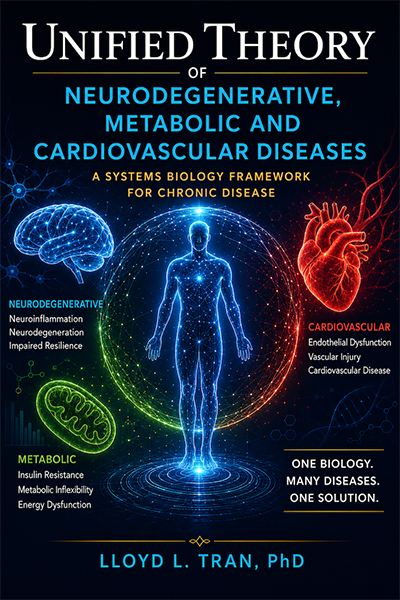
PrefaceThis book represents the culmination of my twenty-five years of scientific research, drug discovery, and clinical development dedicated to understanding the fundamental mechanisms underlying neurodegenerative, metabolic, and cardiovascular diseases. My journey into this field began in November 2001, when I filed a patent application for a novel compound that demonstrated neurogenesis in animal studies for the treatment of dementia and Alzheimer’s disease. At that time, the concept of neurogenesis in the adult mammalian brain remained controversial. During my postgraduate studies in the late 1970s, I was taught the long-standing doctrine that neurons in the adult brain could not regenerate. This belief was rooted in the teachings of Nobel Prize-winning neuroscientist Santiago Ramón y Cajal, who famously declared in his 1928 foundational work, Degeneration and Regeneration of the Nervous System, that in the adult brain, “nothing may be regenerated.” Although pioneering researchers such as Joseph Altman and Gopal Das challenged this doctrine in the 1960s, adult neurogenesis was not widely accepted for decades. Because no approved therapies at the time demonstrated neurogenic activity, it took more than six years to convince the United States Patent Office of the novelty and utility of my invention before the patent was finally granted in 2007. For more than thirty years, Alzheimer’s disease research has been dominated by the amyloid hypothesis, first proposed in 1992. This theory suggests that the accumulation of amyloid-beta (Aβ) plaques is the primary cause of neurodegeneration in Alzheimer’s disease. Over time, the hypothesis evolved into an accepted paradigm guiding much of Alzheimer’s research and drug development worldwide. Yet despite decades of effort and billions of dollars invested, the outcomes have been disappointing. Numerous amyloid-targeting drugs failed in Phase II and Phase III clinical trials, and although three anti-amyloid monoclonal antibodies have recently received FDA approval based on reductions in amyloid plaque biomarkers, meaningful and sustained improvements in cognitive function have remained limited and controversial. These developments reinforced my belief that Alzheimer’s disease cannot be explained by amyloid accumulation alone. As Chairman and Chief Scientific Officer, I have had the privilege of leading a talented team of scientists in advancing NA-831, a small-molecule therapeutic designed to promote neurogenesis and neuronal recovery. NA-831 successfully completed Phase I clinical trials and demonstrated proof of efficacy and safety in Phase II studies for Alzheimer’s disease. We subsequently developed related compounds, including NA-911 for stroke and NA-931 for obesity, which further revealed profound biological connections among neurodegenerative, metabolic, and cardiovascular disorders.
During the course of our research, we observed overlapping patterns involving insulin resistance, chronic inflammation, mitochondrial dysfunction, oxidative stress, vascular impairment, and disturbances in cellular energy metabolism. These pathological features appeared not only in Alzheimer’s disease, but also in obesity, diabetes, stroke, and cardiovascular disease. Our findings were subsequently presented at major international scientific conferences, including the International Conference on Alzheimer’s and Parkinson’s Diseases (AD/PD) 2022 in Barcelona, Spain, the Alzheimer’s Association International Conference (AAIC) 2024 in Philadelphia, and the American Diabetes Association (ADA) 2025 in Chicago , where we reported clinical observations linking Alzheimer’s disease, obesity, and stroke through studies of NA-831, NA-931, and NA-911. These observations led us to question the conventional view that these disorders should be studied and treated as isolated conditions. Increasing evidence suggests that the brain, vascular system, and metabolic system are deeply interconnected through complex biochemical and cellular signaling networks. Disturbances in one system may progressively influence dysfunction in the others through shared pathways involving inflammation, energy metabolism, vascular integrity, and cellular signaling. Through these discoveries, several important questions emerged: Why do insulin resistance and neurodegeneration so frequently coexist? This book is the result of years of scientific observation, experimental investigation, and clinical research conducted at Biomed, together with insights contributed by many researchers around the world. From these collective findings emerged a new realization: neurodegenerative, metabolic, and cardiovascular diseases may not be separate disorders, but interconnected manifestations of a common biological dysfunction. This framework forms the basis of what I propose as the Unified Theory of Neurodegenerative, Metabolic, and Cardiovascular Diseases. By recognizing these diseases as interconnected processes rather than isolated conditions, this theory may open new pathways for prevention, diagnosis, and therapeutic development. Scientific progress has always depended on the courage to question accepted assumptions. In that spirit, this work is offered not as a final answer, but as an invitation for continued exploration, discussion, and discovery. Sir Isaac Newton once wrote: “I seem to have been only like a boy playing on the seashore and diverting myself in now and then finding a smoother pebble or a prettier shell than ordinary, whilst the great ocean of truth lay all undiscovered before me.” I remain deeply grateful to the many scientists, physicians, colleagues, patients, and researchers whose contributions and dedication have made this work possible. The future of medicine may depend not on treating diseases in isolation, but on understanding the biological networks that unite them. If this book contributes in some small way toward a more unified understanding of chronic disease and ultimately toward better therapies for patients, then its purpose will have been fulfilled. Lloyd L. Tran For more information about the book, please visit the website of The Unified Theory of Neurodegenerative, Metabolic and Cardiovascular Diseases.
CONTACT: To contact Lloyd Tran, please complete an online form. Thank you.. -------- © 2026. Lloyd Tran- All Rights Reserved |
|---|